



Meet Your Next DevOps Engineer

Meet your next DevOps Engineer! Our DevOps specialists bring expertise in cloud platforms, CI/CD pipelines, and infrastructure as code. They transform manual deployment processes into automated workflows that save your team countless hours and prevent costly errors.

How Much Does It Cost to Hire A DevOps Engineer?
With Go Carpathian, you can hire skilled DevOps Engineers from Eastern Europe, South Africa, and Latin America at competitive rates compared to Western markets:
United States
Entry Level – Senior
$8,500 - $11,000 / month
- Available on site
- Full Cultural Context
- Scalable Hiring
- Diverse Talent Pool
- Flexible Engagement
Eastern Europe
Entry Level – Senior
$2,000 - $6,000 / month
- Cost-Effective Talent
- High-Quality Expertise
- Scalable Hiring
- Diverse Talent Pool
- Flexible Engagement
South Africa
Entry Level – Senior
$1,800 - $5,500 / month
- Cost-Effective Talent
- High-Quality Expertise
- Scalable Hiring
- Diverse Talent Pool
- Flexible Engagement
Latin America
Entry Level – Senior
$3,500 - $7,000 / month
- Cost-Effective Talent
- High-Quality Expertise
- Scalable Hiring
- Diverse Talent Pool
- Flexible Engagement

What Does A DevOps Engineer Do?
DevOps Engineers connect development and operations teams, automating processes to enable faster, more reliable software delivery.
Here are their key responsibilities explained:
Infrastructure Automation
Design and implement infrastructure as code using tools like Terraform, Ansible, or CloudFormation to create reproducible, scalable environments.
CI/CD Implementation
Build and maintain continuous integration and deployment pipelines that automate testing, building, and deploying applications.
Cloud Platform Management
Configure and optimize cloud services (AWS, Azure, GCP) for scalability, security, and cost-effectiveness.
Monitoring and Logging
Set up comprehensive monitoring solutions and centralized logging to ensure system health and quickly identify issues.
Container Orchestration
Deploy and manage containerized applications using Kubernetes, Docker Swarm, or similar technologies.
Security Implementation
Integrate security practices throughout the development pipeline and infrastructure (DevSecOps).
Performance Optimization
Identify bottlenecks and implement solutions to improve application and infrastructure performance.
Disaster Recovery
Create and test backup and recovery procedures to minimize downtime during incidents.
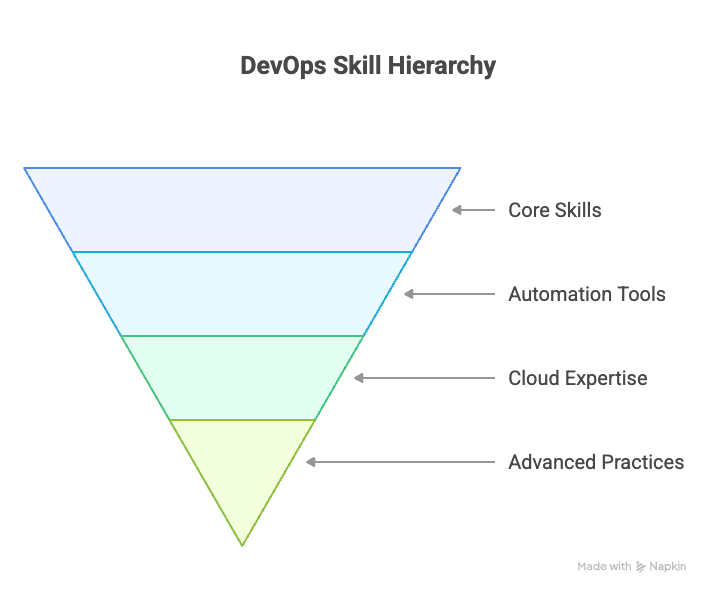
What Skills Do Effective DevOps Engineers Possess?
DevOps Engineers need a diverse skill set spanning development, operations, and automation. These skills allow them to build reliable infrastructure and streamline software delivery pipelines.
Key skills include:
Linux/Unix Administration:
Proficiency in managing and troubleshooting Linux-based systems, including shell scripting and command-line tools.
Infrastructure as Code:
Experience with tools like Terraform, CloudFormation, or Pulumi to define and provision infrastructure programmatically.
Configuration Management:
Knowledge of tools like Ansible, Chef, or Puppet to automate server configuration and application deployment.
Cloud Platforms
Expertise in at least one major cloud provider (AWS, Azure, GCP) and their services, including compute, storage, and networking.
Containerization:
Strong understanding of Docker, container concepts, and orchestration platforms like Kubernetes.
CI/CD Pipeline Tools:
Experience with Jenkins, GitLab CI, GitHub Actions, or similar automation tools.
Scripting and Programming:
Proficiency in languages like Python, Bash, or Go for automation and tooling.
Monitoring and Observability:
Knowledge of tools like Prometheus, Grafana, ELK stack, or DataDog for system monitoring.
Network Fundamentals:
Understanding of networking concepts, DNS, load balancing, and security principles.
Version Control:
Expertise in Git workflows and best practices for collaborative development.
Database Administration:
Basic knowledge of database systems and their operations.
Problem-Solving:
Ability to diagnose and resolve complex technical issues efficiently.
Communication:
Skill in explaining technical concepts to both technical and non-technical stakeholders.
Security Best Practices:
Understanding of security principles and implementation in infrastructure and applications.
Agile Methodologies:
Familiarity with agile development practices and how DevOps integrates with them.

Benefits of Hiring a DevOps Engineer
Bringing a DevOps Engineer onto your team offers substantial advantages that can transform your software development lifecycle. Here’s how they add value:
01
Faster Time-to-Market
DevOps Engineers implement automated CI/CD pipelines that dramatically reduce deployment time. Your business can deliver features and fixes to customers significantly faster. Deployments just work.
02
Improved Reliability
Through infrastructure as code and automated testing, DevOps Engineers create more stable environments, reducing system failures and downtime compared to traditional operations approaches.
03
Cost Optimization
DevOps practices like infrastructure automation and cloud resource management can reduce infrastructure costs through efficient scaling, resource allocation, and elimination of manual tasks.
04
Enhanced Security
Security integrates throughout the development process rather than being added at the end, reducing vulnerabilities and compliance issues by catching them earlier.
05
Better Collaboration
DevOps Engineers foster a culture of shared responsibility between development and operations teams, breaking down silos and improving communication across departments.
06
Scalability
Automated infrastructure allows your applications to scale effortlessly with demand, handling traffic spikes without manual intervention.
07
Continuous Improvement
DevOps Engineers implement monitoring and feedback loops that provide data-driven insights to continuously optimize both applications and processes.
08
Reduced Complexity
By standardizing environments and automating deployment processes, DevOps Engineers reduce the complexity of managing multiple systems and applications.
Frequently Asked Questions
What exactly does a DevOps Engineer do?
A DevOps Engineer combines software development and IT operations skills to automate and streamline the software delivery process. They build CI/CD pipelines, manage cloud infrastructure, implement monitoring systems, and ensure applications can be deployed reliably and efficiently.
How much does it cost to hire a DevOps Engineer?
With Go Carpathian, hiring an experienced DevOps Engineer is cost effective, with rates varying by region: $2,000 – $6,000 in Eastern Europe, $1,800 – $5,500 in South Africa, $3,500 – $7,000 in Latin America, and $8,500 – $11,000 in the US.
What's the difference between a DevOps Engineer and a System Administrator?
System Administrators typically handle day-to-day maintenance of existing systems with less emphasis on automation. DevOps Engineers focus on automation, CI/CD pipelines, and bridging development and operations through code.
Do I need a DevOps Engineer if I'm using cloud services?
Yes. Cloud services provide powerful tools, but DevOps Engineers help you use them effectively. They implement best practices for security, cost optimization, and automation that maximize the benefits of cloud platforms.
How do I know if my company needs a DevOps Engineer?
Consider hiring a DevOps Engineer if you’re experiencing slow deployment cycles, frequent production issues, inconsistent environments between development and production, or if your team spends too much time on manual operational tasks instead of building features.
What tools should a good DevOps Engineer know?
A skilled DevOps Engineer should be proficient with infrastructure as code tools (like Terraform), configuration management (like Ansible), containerization (Docker, Kubernetes), CI/CD platforms (Jenkins, GitHub Actions), monitoring solutions (Prometheus, Grafana), and at least one major cloud platform.

Do You Need Help Hiring a DevOps Engineer?
Having a skilled DevOps Engineer can transform your development process from chaotic to streamlined. Your team stops fighting fires and starts shipping features. One client reported cutting their release cycle from two weeks to twice daily after bringing on a DevOps specialist.
Go Carpathian connects you with experienced DevOps Engineers from Eastern Europe, South Africa, and Latin America at rates that make sense for your business. Our rigorous vetting process ensures you get professionals with proven experience in cloud platforms, automation, and modern deployment practices.
01
Schedule a Discovery Call
Discuss your business needs and goals with their team.
02
Submit an Onboarding Form:
Provide detailed information about the roles you want to fill.
03
Review Calibration Candidates
Evaluate pre-screened candidates to find the best fit for your business.
04
Onboard and Start
Integrate your new team member(s) into your workflow and begin reaping the benefits of outsourcing.
Hear From Our Clients
Discover what our clients say about their experiences and the value we bring to their projects.
Hire top talent from South Africa, Eastern Europe, Latin America (and the US) in under 23 days.
The Go Carpathian initial education and onboarding process is smooth. My clients have been happy with the relationship so far and we’ve onboarded an awesome new hire.

Nate Ruben
Founder, Ruben Digital